On a humid August morning in 2024, Dr. Elena Vasquez sat alone in her Cambridge studio, staring at a photograph that would soon upend more than a century of history.
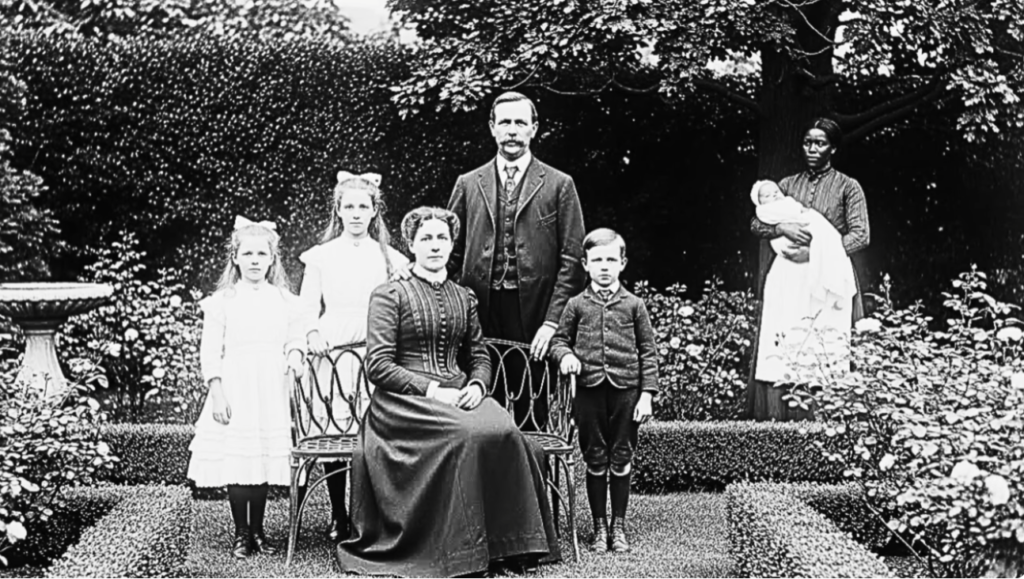
For twenty years, Elena had restored damaged photographs—warped daguerreotypes, sun-faded cabinet cards, brittle prints found in attic trunks. Yet she had never encountered anything quite like the mysterious 1901 image brought to her by the Boston Historical Society. It was, on its surface, a masterpiece of early twentieth-century portraiture: the wealthy Thornton family of Beacon Hill posed in their manicured garden, flanked by elaborately trimmed hedges and framed by the stately façade of their brownstone mansion.
At the center stood the patriarch, Richard Thornton, crisp and imposing in his dark suit. Beside him, his wife Catherine, elegance distilled. Their three daughters stood like lace-draped echoes of their mother, while a young boy—identified in accompanying documentation as their orphaned nephew James—stood between the parents.
A perfect snapshot of privilege.
Elena had been hired simply to restore it. But as she scanned the image at extreme resolution and began drawing contrast from shadows older than any living memory, she noticed something the original print had concealed.
There was someone else in the garden.
Barely visible at the far edge of the frame, half-concealed behind an oak trunk, stood a woman—a Black woman—dressed in the simple uniform of a domestic servant. She was positioned just so: visible, yet unseen. Hidden, yet present. And in her arms she held an infant swaddled in white cloth.
When Elena enhanced the shadows, the woman’s face emerged: dignified, sorrowful, and somehow defiant. The infant’s face, though blurred by age and early motion, appeared light-skinned. Almost startlingly so.
A chill crept through Elena’s body.
There was nothing unusual about domestic servants appearing in wealthy families’ photographs. But this was different. This woman stood not as background decoration, but as someone deliberately placed—and then deliberately ignored.
And the child she held… Who was this baby?
The documentation identified only the family in the foreground. Nothing—a glaring nothing—about the woman in the shadows.
Elena sensed a story begging to be told.
RUMORS BURIED IN PAPER
By evening, Elena’s wall was dominated by a large print of the enhanced image. She could not stop staring at the servant woman—her posture, her gaze, the protective curve of her arms around the infant. Something had been hidden in that frame for 123 years.
The next morning, Elena called Dr. Patricia Chen, curator at the historical society.
When Elena described the hidden figure, Patricia grew instantly alert.
“The Thornton family donated these materials just months ago,” she said. “They said nothing about… any of this. Do you think there’s a real story here?”
“I’m certain of it,” Elena replied. “But I need access to everything.”
Patricia granted it.
Together, they plunged into the Thornton papers: ledgers, household account books, letters, property records. Months collapsed to hours as Elena pored over brittle pages.
In the 1901 household ledger, she found it:
Clara Washington — Cook and Housemaid — $8/month + room.
Employed 1899–1902.
Beside the sudden termination in 1902 was a single word, circled: dismissed.
A few hours later, Patricia unearthed a letter that made both women stop breathing for a moment. Catherine Thornton had written to her sister in March 1901: “We have taken in Richard’s nephew James… though the circumstances of his arrival have been complicated by unfortunate rumors. I assure you these rumors are entirely without foundation. James is our blood relation… We have made certain household adjustments to ensure propriety is maintained.”
Rumors. Adjustments.
A scandal.
And the next discovery twisted everything further. James’s birth certificate had been amended. His parents, supposedly dying of cholera in 1896, had actually died in 1898. The dates didn’t match. Neither did the place of birth.
Something was wrong. Deeply wrong.
Elena studied the photograph again that night, zooming in until the pixels broke apart.
The baby in the servant’s arms was far too young to be James.
Which meant the Thornton garden held two children that day.
Two children who were never supposed to be seen together.
THE HIDDEN MOTHER
The breakthrough came from Boston Lying-In Hospital records. There, among the fragile ledgers, Elena found two entries:
-
February 1896: Clara Washington, Negro domestic servant—delivery of male infant. Hospital fees paid by R. Thornton.
-
March 1901: Clara Washington—delivery of female infant. Fees again paid by R. Thornton.
The father each time was listed as unknown.
But the pattern was unmistakable.
Further searches revealed Clara’s heartbreaking 1902 letter to her church pastor: “They say James will remain with them… that I am unfit to mother him. They offer money for my silence. I am a Negro woman with no power.
If I fight, they will destroy me—and perhaps harm James too.”
Elena’s hands shook as she read.
Clara had been forced to surrender both children: James to the Thorntons, and her daughter to an orphanage.
But one act of resistance remained.
She had stood in that photograph, holding her baby—refusing to be unseen.
THE CHILDREN GROWN
Tracing James Thornton through the decades revealed a man of startling accomplishment—and startling contradictions.
Raised white. Educated at Harvard. A respected attorney.
And yet, in the 1930 census, a tiny notation appeared beside his race entry:
Mulatto — amended to White.
Rumors had followed him.
By the 1930s, James was defending Black families in housing discrimination cases. By the 1950s, he was a leading civil rights attorney. His speeches hinted at a secret pain beneath his polished veneer: “There are people whose love and sacrifice shape us though history refuses to record their names.”
Did he know?
Elena needed answers. She reached out to James’s grandson, Michael Thornton—a retired professor of African American history.
He told her he’d been waiting for a call like this.
Then he handed her a letter his grandfather had written in 1974.
In it, James confessed everything.
Clara had found him in 1932, aged and frail, revealing herself as his mother.
She showed him the baptismal record.
The altered birth certificate.
And the photograph—this photograph.
He confirmed it all before she died in 1935.
Her love had shaped him more deeply than even he’d realized.
“I became a civil rights attorney because I understood personally how the color line destroys families. Michael, if you can, find my sister. Find Clara’s daughter.”
REUNION AFTER A CENTURY
The public unveiling of the restored photograph in November 2024 was explosive. Headlines swept across the country. Social media lit up with debates over hidden ancestry and racial passing.
Then came the email from Harlem.
A woman named Diane Roberts, aged 79, believed she was descended from Clara’s daughter.
She had a photograph—cropped, old, and delicate—showing only a Black woman holding an infant in a garden.
The same image Elena had restored, but trimmed to exclude the white family.
Someone had given it to Diane’s grandmother in 1901.
An act of mercy. A lifeline across generations.
Elena arranged a meeting. When Diane saw the full photograph—the one showing Clara holding her—she wept openly. “She loved me,” Diane whispered. “You can see it in how she holds me. She loved me.”
More genealogists came forward. DNA results confirmed it: Diane was Clara’s descendant. So was another woman, Linda, whose grandmother had been adopted in 1901.
Three branches of Clara’s family—Black, white, mixed—came together again for the first time in 123 years.
CLARA’S LEGACY
The descendants commissioned a new headstone for Clara.
CLARA WASHINGTON
1875–1935
Beloved Mother
Her strength lives on in her descendants
More than one hundred people attended the dedication—descendants, historians, former students of Clara’s daughter, and civil rights advocates inspired by James’s work.
Elena spoke: “Clara was pushed into the shadows. But she refused to disappear. She made sure she was in that photograph—visible enough to be found one day.
And 123 years later, we finally saw her.”
Soon afterward, Elena’s work anchored a national museum exhibition:
Hidden Histories: Black Women in the Shadows of American Photography.Best cameras
The Thornton photograph became iconic, symbolizing both a wound and a healing.
Families across the country brought their own mysterious photographs, their own suspicions, their own hidden histories.
Clara’s descendants founded the Clara Washington Foundation, dedicated to helping African Americans locate ancestors lost to Jim Crow–era separations.
FULL CIRCLE
In 2026, on the 125th anniversary of the photograph, the descendants gathered in what had once been the Thornton garden—now a public park.
They planted a tree in Clara’s honor.
When Elena looked out over the reunited family—Black, white, multiracial—she understood the full scope of what she had uncovered.
A photograph meant to obscure had instead revealed.
A woman meant to be hidden had become a beacon.
A family meant to be divided had grown back together.
Clara Washington had stepped from the shadows at last.
Seen. Known. Honored.
And never, ever forgotten.