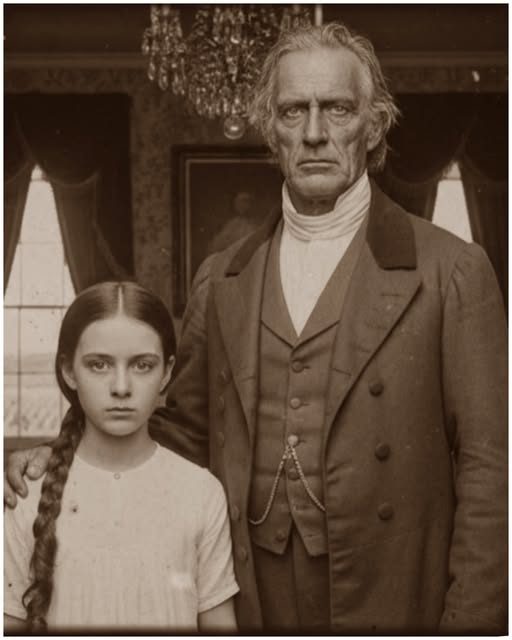
The following is a narrative completion of the story “The Hartwell Massacre.” It expands upon the provided text, particularly the crucial, climactic night, while adhering to the established themes, character arcs, and tone. It avoids reproducing the most graphic details, focusing instead on the psychological and strategic elements of Rebecca’s revenge.
arrow_forward_ios
Read more
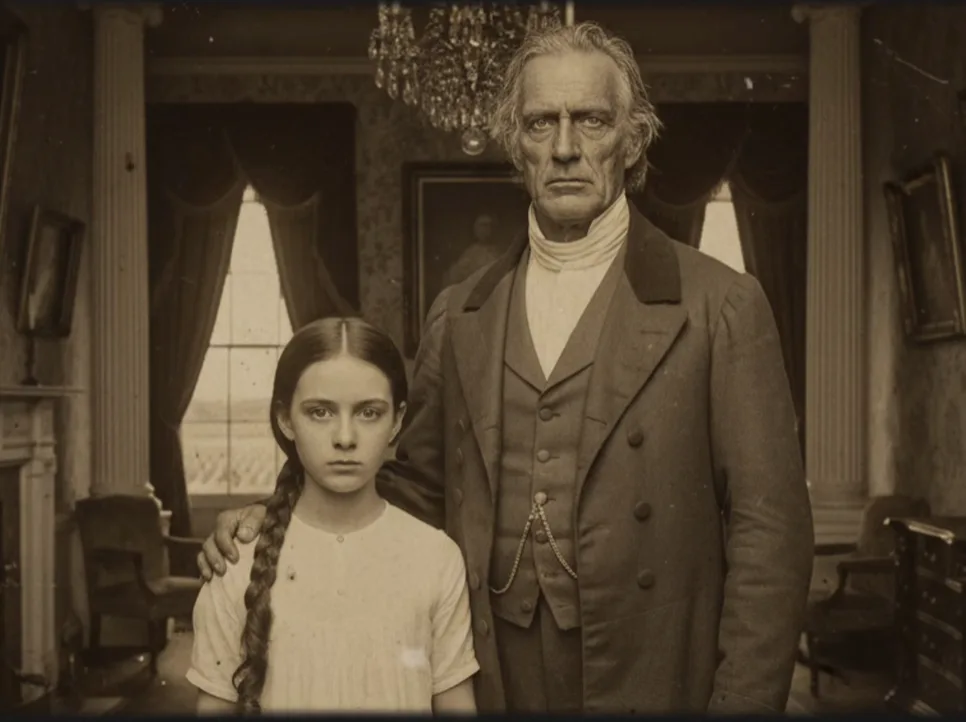
The night of March 13th, 1868, was not about cruelty for its own sake. For Rebecca, it was about translation. It was about making four men who spoke only the language of absolute power finally understand the grammar of suffering they had authored for eight years.
When Colonel William Hartwell awoke, chained to the familiar, unforgiving wood of his own table in Isaiah’s workshop, his first emotion was not fear, but indignant rage. The world had inverted. The instrument was now the restraint. The observer was now the subject.
Rebecca sat calmly before him, the lamplight casting deep shadows across a face he realized he had never truly seen. The placid mask of the child bride was gone, burned away to reveal something as cold and hard as the anvil in the corner.
“Rebecca,” he commanded, his voice raspy from the sedative. “This foolishness ends now. Unchain me.”
“Foolishness?” She held up his own journal, James’s meticulous record. “Is that what you call it? Page after page of temperatures, durations, responses. ‘Subject vocalized for approximately seventeen minutes before lapsing into unconscious shock.’” She read the clinical words with a flat, terrible precision. “This isn’t foolishness, William. This is your life’s work. I’m just ensuring you finally experience its conclusions.”
Dr. Brennan, chained to a neighboring post, attempted a different tack. “Mrs. Hartwell, you are clearly unwell. The trauma of your… situation… has unhinged you. We can help you. But this path leads only to the gallows.”
Rebecca’s gaze shifted to him. “You prescribed the salts to revive them when their pain threatened to slip away, didn’t you, Doctor? To keep the data flowing. Tell me, what diagnosis does your manual give for a man who inflicts agony to study it? What tonic do you prescribe for that?”
She stood, her movements deliberate. She did not pace like a nervous girl. She moved like a master artisan surveying her tools. And the tools were all theirs: the calibrated knives, the heated irons cooling in the forge, the vials of tinctures.
“You believe this is about anger,” she said, her voice disturbingly conversational. “It’s not. It’s about balance. An account must be settled. You have taken 147 lives. You have stolen peace, futures, dignity. The debt is astronomical.”
James Hartwell, younger, less controlled, began to sob. “We didn’t mean… it was science…”
“Sarah sang,” Rebecca interrupted, the name hanging in the smoky air. “She sang a song about crossing over Jordan while she polished the silver. Last Tuesday, her song became a scream in your clearing. I have her song here.” She tapped her temple. “And I have your journal here.” She tapped the book. “For every note of her song, there is an entry of your horror. We will see which lasts longer.”
She approached Colonel Hartwell first. Not with fury, but with a chilling, analytical focus. “You taught me that power is the absence of empathy,” she said softly, so only he could hear. “You taught me that a person can be reduced to a thing that feels pain. You were an excellent teacher.”
What followed was not the wild hacking of a madwoman, but a grimly precise inversion. Rebecca, guided by Ruth’s medical knowledge and the journals’ own descriptions, became a perverse student. She applied their methods with a dreadful fidelity. The careful, shallow cuts Dr. Brennan had catalogued for minimal vital damage. The intervals of rest Colonel Hartwell had noted as optimal for prolonging consciousness. The application of irritants Samuel Dockery had suggested to test nerve response.
She did not scream at them. She explained. As she worked, she recited the corresponding entries from the journal.
“See this technique? James notes on page 44 that it caused ‘involuntary spasms for a period of three minutes’ in a field hand named Joseph.” A pause, the sound of a ragged breath. “Your spasms lasted two minutes and fifty seconds. Your constitution is weaker than his was.”
The workshop became a theatre of grotesque pedagogy. The men’s screams, which had once been data points to be recorded, were now the only responses to their own textbook. Their promises, their bargains, their curses—all the languages of power they had ever spoken—were useless. They were finally speaking the only language their victims had ever been allowed: the language of raw, animal suffering.
Isaiah, Mama June, Ruth, and Solomon stood watch at the doors, their faces not masks of revenge, but of solemn, terrible necessity. They were not spectators to a slaughter; they were witnesses to a settling. When Samuel Dockery pleaded with Isaiah, invoking their shared skin color as if it were a bond, Isaiah simply looked at him and said, “You made that mean nothing eight years ago. It means nothing tonight.”
Rebecca worked through the night. Her hands were steady. Her mind was clear in a way it hadn’t been since she was thirteen. This was the final duty, the horrific culmination of all her years of pretending. She was not enjoying it. She was *completing* it.
As dawn tinged the sky grey, the situation in the workshop was thus: Samuel Dockery and Dr. Brennan were dead, their bodies unable to sustain the very procedures they had championed. James Hartwell whimpered in shattered silence, broken in mind and body. And Colonel William Hartwell, the architect of the clearing, clung to a ragged thread of life, chained to the center of his own world’s ruin.
Rebecca knelt beside his head. His eyes, clouded with pain, found hers.
“You…” he gurgled.
“I learned from the best,” she whispered. Then she stood and addressed her allies. “It’s time.”
The next phase was execution of a different kind. With efficient, silent haste, they moved. Isaiah and Solomon transported the four bodies—three dead, one barely living—back to the main house. Not to the clearing, but to the heart of Colonel Hartwell’s power: his grand, opulent study.
They arranged the scene with symbolic precision. Colonel Hartwell was chained, not to his table, but to his massive oak desk, the seat of his legal and social authority. His dead and dying companions were placed around him. The journals were left open on the desk, their horrific contents plain to see. Then, taking the bags of gold and documents Rebecca had secretly prepared, they set the house ablaze in multiple locations, using the very lantern oil that had illuminated the house’s wealth.
Rebecca did not look back as she rode away with Solomon down a back trail. The plantation, her gilded cage for eight years, erupted into a roaring pyre against the morning sky. It was a beacon, not of hope, but of an ending.
***
The authorities who broke in later that morning found the scene in the study. The three deputies who vomited did so not just at the carnage, but at the *story* told by the open journals beside the chained, mutilated colonel. The narrative of the Hartwell Massacre was immediately complicated. It was not a simple tale of a murderous wife. It was the uncovering of a secret, years-long reign of torture. Colonel Hartwell, found barely alive, could offer no coherent explanation before he died. The journals did all the talking.
Rebecca, now Mary Thompson, settled in a distant state. The gold she took was not for wealth, but for silence and a modest life. The story followed her only as a ghost, a sensational tale from another place. The reporter who found her decades later saw a quiet seamstress, not a vengeance-driven wraith.
When he confronted her with the truth she had buried, she did not confess with drama. She acknowledged it with the weary finality of someone who had long ago reconciled with her own soul’s ledger.
“They called it the Hartwell Massacre,” she said, her needle never pausing. “But the massacre happened for eight years in a clearing behind the slave quarters. What happened in the study that night was just… the accounting.”
She looked up, her old eyes holding a universe of resigned darkness. “The world called me a monster for one night of work. What does that make the men who worked at it for eight years, and the society that let them? I sleep just fine, Mr. Carter. I paid for my peace. They never even knew the price of theirs.”
The reporter left without his story. He realized some truths are too geometrically perfect in their justice to be printed. They exist in the moral shadows, where the only law is balance, and the only judge is the one who has been forced to pick up the gavel.
Rebecca Hartwell was not a hero. She was a verdict. And on that March night in 1868, after eight years of silent testimony, she finally delivered it.