THE BRIDE WHO NEVER BREATHED
The experts at the San Francisco estate auction believed it was only a wedding portrait—another stiff, formal relic of Victorian sentimentality. But Dr. Emily Chen saw something else the moment her eyes landed on it.
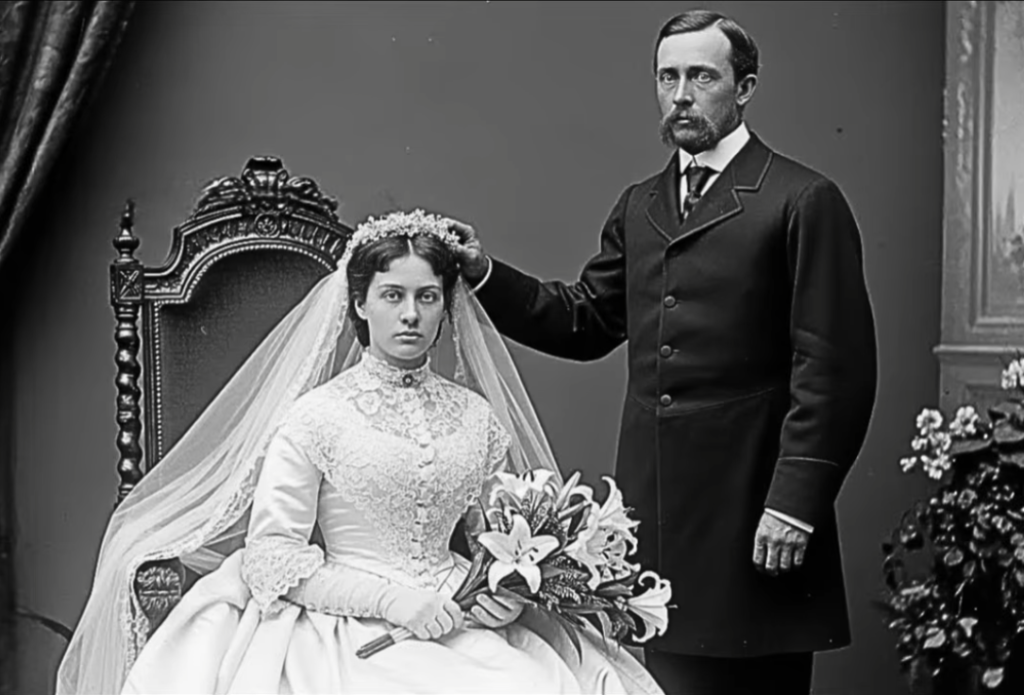
Amid the cluttered display tables and murmured haggling of bidders, the portrait seemed almost to call to her. Encased in an ornate silver frame, filigree curling like frost across glass, the image inside was dated simply 1884. The bride sat in a sculpted chair, her gown a shimmering cascade of silk and lace. The groom stood beside her in black wool, one hand on the chair’s back, the picture of Victorian reserve.
And yet—
Emily couldn’t look away.
She was a specialist in nineteenth-century photography—fifteen years at the California Historical Society had trained her eye to see what others missed. At first glance the portrait was textbook perfect: the rigid posture, the carefully controlled lighting, the long-exposure stillness.
But the bride’s face held something terribly wrong.
Her posture was too rigid. Her eyes stared not at the camera, but through it. And the groom’s expression—Emily had seen genuine joy, pride, even boredom in wedding portraits. But never grief. Never this barely restrained anguish.
“Lot 247,” the auctioneer announced. “Victorian wedding photograph, circa 1884. Silver frame. Provenance: Whitmore estate. Opening at two hundred.”
Emily raised her paddle before she registered the movement.
She was outbid. Then again. She refused to yield. Her instincts—sharp, honed, unerring—insisted this photograph mattered.
The hammer fell at $850.
She cradled the wrapped portrait in the passenger seat of her car, unable to explain even to herself why she felt protective of it. She had no way of knowing that the truth inside that frame had remained frozen for 140 years—waiting for her.
The Bride Who Did Not See
Emily arrived at the museum before sunrise the next morning. The conservation lab glowed sterile and cold, but the moment she freed the photograph from its frame she felt heat rising in her chest.
The backing was original. Heavy cardboard, stamped in fading ink:
Morrison & Associates
Memorial Photography
San Francisco, California
She stared at the words.
Memorial photography.
Post-mortem photography.
Her pulse quickened.
Victorian families often commissioned portraits of their dead. Infants, children, whole families gathered around a lifeless member for one last likeness. But a wedding portrait?
Emily placed the photograph beneath the museum’s highest-resolution scanner. When the digital image appeared, magnified and crisp, her suspicions hardened into certainty.
The bride’s hands—carefully arranged around her bouquet—were stiff, discolored beneath powder. The skin tone of her fingers did not match her face. The lips, painted delicately, bore bluish undertones beneath the rouge.
Her eyes contained no catch-light.
No reflection of life.
Behind her veil, concealed under the studio’s drapery, a metal posing stand held her upright. A small wire brace at the base of her skull kept her head aligned. The long exposure had rendered the tell-tale droop in her neck invisible—but the evidence was there, buried in grain and shadow.
Emily sat back, breath shallow.
The bride was dead.
And someone had staged this—this grotesque imitation of joy—as a wedding portrait.
But why?
The Engagement That Vanished
Over the next week, Emily traced the studio, Morrison & Associates, through nineteenth-century business directories. The name appeared consistently between 1878 and 1891, always listed under “memorial services” rather than general photography.
A specialty studio for post-mortem work.
Then came the biggest clue: the photograph had come from the Whitmore estate. Emily contacted the San Francisco Genealogical Society, and a researcher named David unearthed the first thread of the unraveling truth.
“There was a wedding announcement,” he said. “June 15th, 1884. Victoria Whitmore to marry James Ashford. Big deal—two of the city’s wealthiest families.”
Emily waited.
“But here’s the strange part. No record of the wedding actually taking place. No social column. No guest lists. Nothing. The announcement appeared—and then silence.”
“And Victoria?” Emily asked.
“Died June fifteenth. Same day she was supposed to be married. Cause of death: typhoid fever.”
Emily closed her eyes.
So the groom stood beside the bride—not as her husband, but as a bereaved fiancé forced into something unspeakable.
She studied the portrait again.
The grief in James Ashford’s eyes made achingly perfect sense.
The Letters Hidden in the Walls
Emily visited the former Whitmore mansion—now luxury apartments perched atop Nob Hill. With the manager’s permission, she descended into the archive room, a climate-controlled trove of forgotten history.
Robert, the property manager, pulled a folder labeled 1880–1889.
Inside the folder were letters—intimate, fragile, scrawled in elegant Victorian script.
The first was from Victoria’s mother, Eleanor.
Preparations for the wedding continue, though Victoria grows weaker by the day. The doctor insists it is only nerves. James visits daily, bringing flowers, reading to her. He is devoted. The wedding must proceed. Too much has already been arranged…
Another letter, dated June 10th:
Victoria worsens. The doctor now suspects typhoid. He urges postponement. But Richard refuses. He says the scandal would be unbearable… Victoria is barely able to stand, yet Richard insists she will be well by Sunday.
Emily’s hands trembled as she read.
Robert produced a second bundle—found behind a wall during a 1998 renovation. Letters James had written to Victoria during her illness.
I would wait a lifetime, he wrote. Your health is all that matters.
Another:
Your father refuses to postpone the wedding. He called me dishonorable for suggesting it. I don’t know how to help you.
And then, June 14th:
The doctor says you are dying. Your father says the ceremony will proceed regardless. If you pass before tomorrow… he will handle it discreetly. I do not understand. I fear I do.
Emily’s eyes blurred.
The final letter, dated June 16th, was almost too painful to read:
Your mother told me you died during the night. They still forced the photograph. They dressed you in your gown… propped you upright… told me to stand beside you. I refused until your father threatened to destroy my family’s bank.
I am ashamed, Victoria. I will never forgive myself.
The letters fell from Emily’s hands.
The photograph was not merely evidence of Victorian mourning culture.