THE GIRL WHO WOULD NOT LET GO.
You’re looking at a photograph from 1888.
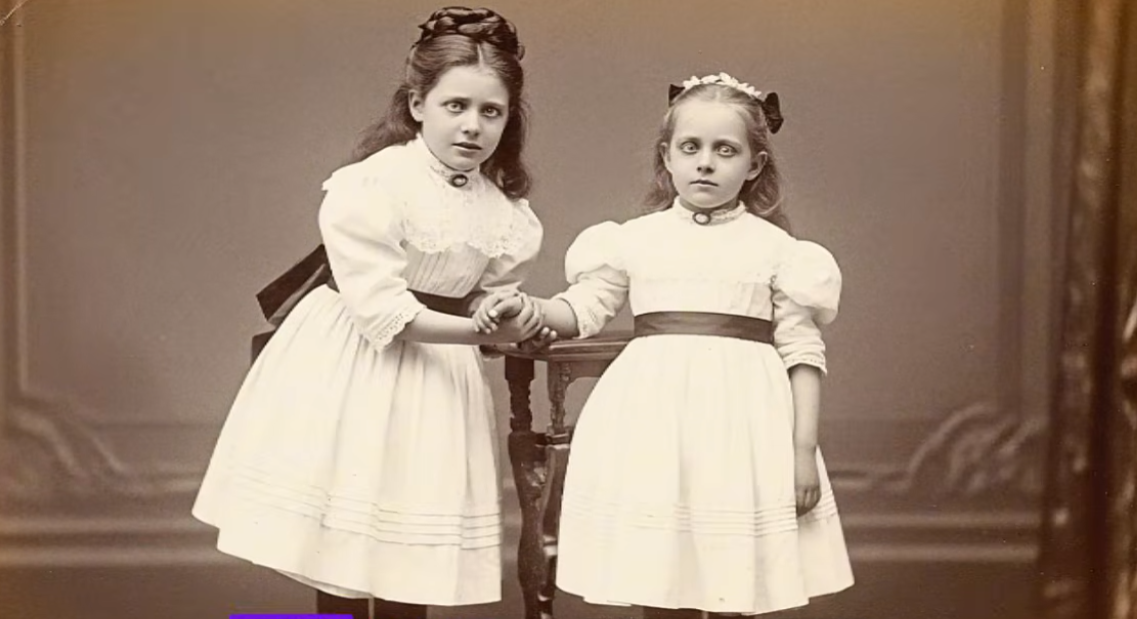
Two young girls stand side by side in a Victorian photography studio, posed before a painted backdrop of classical columns and draped fabric. The older girl—perhaps twelve—holds the hand of her little sister, who looks no more than seven. They wear matching white dresses trimmed with dark ribbons. At first glance, it’s the sort of sweet, solemn portrait wealthy Victorian families commissioned to document childhood: two sisters, dressed like angels, immortalized in soft light.
But in 2024, when digital restoration specialists cleaned away 135 years of damage, they uncovered something that transformed this innocent portrait into evidence of one of the darkest practices in Victorian photography.
Only one of these girls was alive.
THE PHOTOGRAPH THAT SHOULDN’T HAVE SURVIVED
In March 2024, Christie’s auction house in New York received a consignment from the estate of Margaret Brennan, a collector who’d spent four decades amassing one of the world’s largest private archives of Victorian photographs. Among the thousands of images was a small cabinet card—a popular style in the 1880s.
The photograph showed the two girls standing in Morrison & Sons Photographic Studio, Philadelphia. On the back, written in elegant script beside the photographer’s mark, were the words:
“Clara and Emiline. May 16th, 1888. Together, always.”
The image was deteriorated almost beyond recognition. Foxing covered a third of the surface. Water damage crept up from the lower edge. Creases cut across the girls’ pale faces. Around the younger child’s jaw and neck was a darker stain—oddly localized, strangely deliberate.
Christie’s senior photography specialist, Dr. Amanda Chen, noticed something immediately. The older girl’s outline showed faint motion blur—normal for the 8–15 second exposures of 1888. But the younger girl? Not a hair out of place. No blur. No motion. No softness.
Perfect stillness.
And the way the older girl held the younger’s hand—her fingers wrapped not around the palm but around the wrist, knuckles white—looked wrong. Not affectionate. Supportive. As if she were preventing the arm from falling.
Dr. Chen had seen photographs like this before.
She suspected this was post-mortem photography—but with a twist so disturbing it made her stomach turn.
She sent the image for a full digital restoration.
Six weeks later, she received the restored file.
She took one look and called the head of acquisitions.
“We can’t auction this,” she said. “This belongs in a museum. And the public needs to understand what they’re looking at.”
THE TERRIFYING FACE THE DAMAGE HAD HIDDEN
Restoration peeled away 136 years of grime to reveal a truth no one expected.
Clara’s expression—once a blur of stains and fading—was now horrifyingly clear.
Victorian portraits are stern by nature, but this was different. Clara’s eyes were wide, too wide, showing crescents of white around the irises. Her pupils were blown with fear, her brow drawn into a child’s desperate attempt to keep control. Her lips were pressed so tightly together they’d gone bloodless at the corners.
This wasn’t photographic seriousness.
This was terror.
But the most damning detail was her hand. What looked in the damaged photo like a normal hand-in-hand pose was revealed to be Clara holding her sister’s wrist, thumb pressed deep enough to leave a mark.
A mark consistent with pressure applied to skin already undergoing post-mortem lividity.
She wasn’t holding her sister.
She was holding her sister up.
Behind the younger girl’s dress, faint but undeniable, restoration revealed the metal frame of a post-mortem posing stand.
The younger child, Emiline, had been dead for at least 24–48 hours when this photograph was taken.
Her sister knew it.
FORENSIC EVIDENCE OF A CHILD’S FINAL HOURS
Dr. Robert Martinez, forensic pathologist specializing in historical photographs, examined the restoration.
His findings were devastating.
Skin tone: waxen grey with greenish tinge—early decomposition.
Eyes: slightly open, showing brownish discoloration of tache noir.
Jaw: slackening consistent with the end of rigor mortis (36–48 hours after death).
Skin texture: shiny, cosmetic-treated—common in Victorian corpse preparation.
Posture: unnaturally perfect, supported by a hidden posing stand.
Arm: limp but positioned by an external stand and Clara’s grip.
Emiline hadn’t just died recently.
She had been dead long enough for rigor mortis to come and go.
This was not a photograph taken immediately after death.
The Hartwell family kept the corpse for three days—long enough to dress, rouge, perfume, and pose her—then forced their living daughter to hold her.
THE MOST DISTURBING GENRE OF VICTORIAN PHOTOGRAPHY
To understand what Dr. Chen uncovered, you must understand Victorian grieving customs.
Most post-mortem photographs acknowledged death openly.
But “Sleeping Beauty” portraits tried to deny it entirely.
Deceased children—almost always girls—were posed as if alive:
stood upright in posing frames
dressed to match living siblings
eyes forced open or painted onto lids
hands arranged to simulate life
placed in ordinary photo studios rather than funeral parlors
And living siblings were often posed beside them.
The illusion was meant to comfort grieving parents.
But it came at the expense of the surviving children’s psychological safety.
Even Victorian doctors condemned the practice.
THE HARTWELL FAMILY
Dr. Chen traced the girls through Philadelphia archives.
Clara Louise Hartwell
Born November 3, 1875
Died 1942, age 66
Emiline Rose Hartwell
Born April 8, 1881
Died May 13, 1888 of diphtheria
The photograph was taken May 16, 1888—three days after Emiline’s death.
But it was a letter in the Hartwell family papers that revealed the emotional truth behind the photograph.
Written by their mother, Catherine Hartwell, to her sister Mary, dated May 20th, 1888, it described the day of the photograph in heartbreaking detail:
Clara’s silence.
Her refusal to eat.
Her refusal to let anyone touch the hand that had held Emiline’s.
Her claim that she could still feel the cold.
“Mr. Morrison had done his best with perfumes and powders, but Mary—our darling had been gone for three days. There was a smell Clara knew.”
The mother admitted she’d watched her daughter stand there, forced to hold her dead sister for the full fifteen-second exposure, while the photographer counted aloud.
“Fifteen seconds, Mary. Fifteen seconds.”
THE LIFE THAT FOLLOWED
Dr. Chen located Clara’s psychiatric records.
Clara was institutionalized twice as a teenager for “melancholia” and “nervous disorder.”
Her symptoms, described in archaic terms, are recognizable today as severe PTSD:
recurring nightmares
compulsive hand-washing until bleeding
panic attacks
hallucinations of a cold hand touching hers
She never married. Never had children.
She worked as a seamstress until her death in 1942.
In her will, she wrote: “I do not wish to be remembered as the girl in that photograph.”
She ordered all childhood photographs of herself and Emiline burned.
Twenty-two were.
One wasn’t.
The cabinet card found its way into an antiques shop, then a collector’s hands, and eventually the Brennan estate.
Clara spent her entire adult life trying to escape that photograph.
It survived her by eighty-two years.
THE MODERN RECKONING
Dr. Chen published her findings in June 2024.
The academic world—and the public—exploded with shock.
Families sent more than two thousand photographs for evaluation. Many turned out to be Sleeping Beauty images where the living siblings never realized they had posed with the dead.
Harvard trauma psychologist Dr. Patricia Owens, who had spent fifteen years researching Victorian mourning trauma, published a companion paper summarizing the psychological toll.
Children forced into Sleeping Beauty portraits showed:
Immediate effects:
nightmares (73%)
mutism or severe speech reduction (64%)
phobias of cold, dark, or touch (81%)
panic attacks (45%)
Long-term effects:
chronic PTSD (58%)
refusal to marry/have children (67%)
psychiatric institutionalization (42%)
requests for destruction of photographs (89%)
Clara’s case was textbook.
Old enough to understand death.
Forced to touch and support the corpse.
Exposed to the smell and temperature of early decomposition.
Compelled to remain perfectly still while a man counted to fifteen.
“For a 12-year-old child, this isn’t a macabre ritual. It’s trauma. Deliberate, lasting trauma.” —Dr. Owens
THE PHOTOGRAPH TODAY
The image now resides at the National Museum of American History in an exhibit titled: “THE HIDDEN COST OF VICTORIAN MEMORY: When Photography Became Trauma.”
Beside the photograph hangs Clara’s medical record, her mother’s letter, and the restored image showing the terror she fought to conceal.
The placard reads: “Clara Louise Hartwell, age 12— forced to pose holding her deceased sister’s body. Traumatized for 54 years. Requested this photograph be destroyed. We display it now to acknowledge her suffering and the suffering of countless children like her.”
A PICTURE WORTH A THOUSAND FEARS
For 136 years, stains and fading had hidden the truth.
Now restored, the photograph shows exactly what it always was:
Not a portrait of sisterly affection.
Not a sentimental token of mourning.
But the documentation of a child being forced to hold her dead sister while adults watched and a photographer counted aloud.
The moment a 12-year-old girl understood death not as a concept, but as a weight—cold, stiff, and resting in her palm.
Some photographs preserve memories.
Some preserve nightmares.
And some—like the photograph of Clara and Emiline—should come with a warning.